It’s
November and the month of Thanksgiving. With much gratitude for a very
useful plant, I thought I’d write about an herb that is often used in
traditional turkey stuffing, or dressing, as some say. That herb is
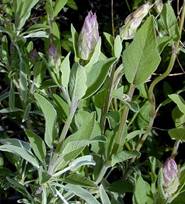
Garden Sage, Salvia officinalis.
Garden Sage likes to grow in the full sun and in dry soil. It is a native to
the northern shores of the Mediterranean and likes our limestone soils or
lack of soil. Sage is a good garden plant for Central Texas. The light
gray/green leaves are a beautiful contrast to the darker green of many of
our garden plants, and in the spring, if you’re lucky, a profusion of
luscious pink flowers will bloom and last quite a long time. Even
though Sage is a perennial herb, in Texas it seems to last only about three
years. Then becomes leggy and thins out, so it needs replacing.
Sage
is not only tasty but it has several strong medicinal properties. The
leaves of Sage act as a powerful astringent, slowing down the secretions of
fluids. A Sage tea can be used for excessive sweating (including those night
sweats), vaginal discharge, and diarrhea. Sage will stop the flow of
mother’s milk, so use it only if you are ready to wean a nursing baby. The
Native Americans rubbed the fresh leaves of Sage on their teeth as a
cleanser as well as using it to treat infected gums and mouth ulcers.
When I get an annoying canker sores inside my mouth, I simply go out in to
the garden, pick a Sage leaf or two, chew it a bit and then place it on the
sore. I leave this poultice on the sore for an hour or so and soon the
irritation is eased and the sore begins to disappear.
Sage
tea, mixed with honey and lemon is excellent for sore throats and colds.
You can also gargle with the tea. Add a little apple cider vinegar as
a bonus to aid in the healing process. Finally, Sage, most often White
Sage, Salvia apiana, is used by Native Americans and by many
spiritual groups as a Smudge Stick to clear the environment of negative
energy.
It is
important to limit the use of Sage to only a week or two. Sage
contains a volatile oil, Thujone, which may act as a neuro-toxin.
Therefore, overdoses, or long term use of Sage, may be detrimental to the
functioning of the nervous system.
When taking responsibility for using herbs for your health, it is always
wise to be aware of any contra-indications related to the use of the herb.
For the most part, herbs are very safe and have little side effects.
I
hope you will enjoy using Sage in turkey stuffing to flavor the bird as well
as to aid in the digestion of fatty foods. Enjoy the benefits of
drinking Sage tea, as needed for sore throats and remember to incorporate
Sage when a strong astringent action is needed. Have a wonderful
Thanksgiving holiday.